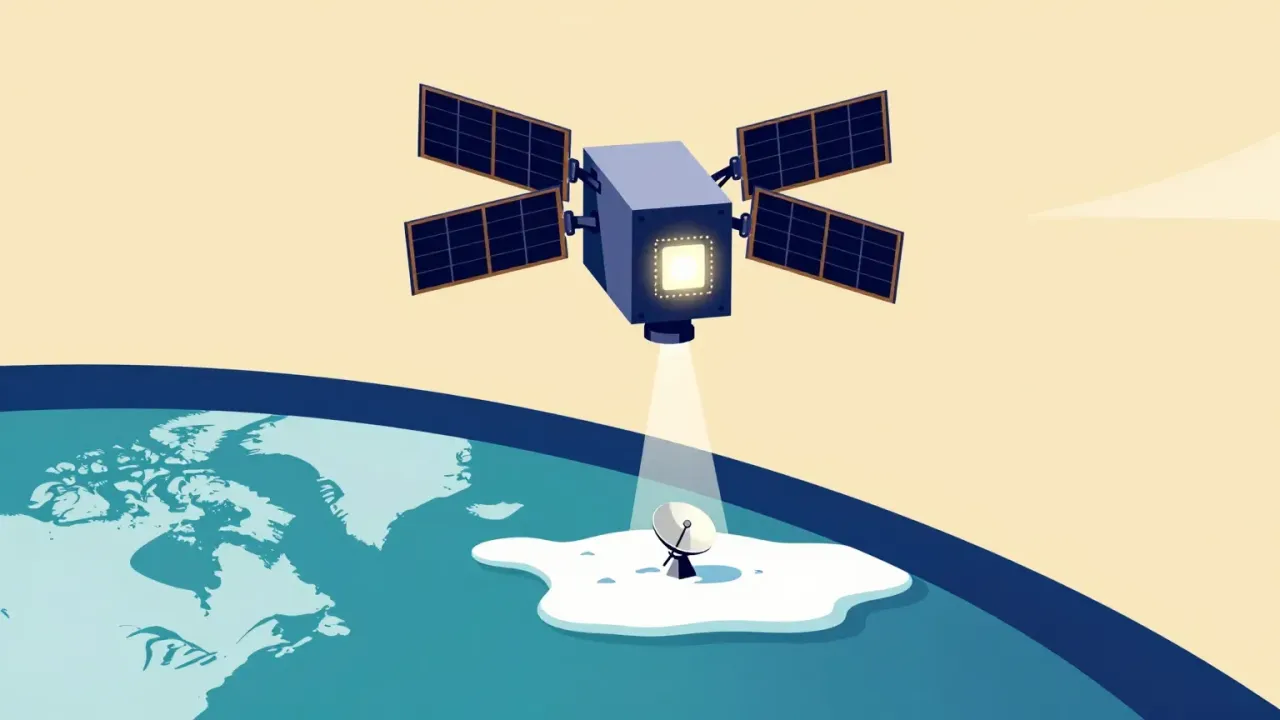
Google says its Project Suncatcher prototype satellite has produced what the company calls the first-ever AI response from a data-center-class TPU in orbit. In an October 30, 2026 post, Travis Beals, Google's senior director for Paradigms of Intelligence, said the team reached its "Hello World" milestone this week, roughly a month after the satellite launched on October 1.
The test itself was deliberately simple. During a ground-station pass, engineers uplinked a prompt to the open Gemma 4 model preloaded on the spacecraft, asking it to write a haiku about being in space. The reply came down as the satellite passed over Svalbard, Norway: "Blue marble below / Data streams in silent grace / Starlight feeds my core." Google says it followed up with space-themed limericks and with telemetry prompts that asked the model to report the technical status of the payload's systems.
Getting to that point took about three weeks of commissioning, according to Google and TechCrunch. The checklist included powering up the satellite's host computer and TPU trays and running early machine-learning tests. TechCrunch reports that the spacecraft, which launched alongside more than 100 other spacecraft on a SpaceX Falcon 9, carries four Google TPUs and generates up to 1 kilowatt of power, enough to run only one TPU at a time for about 20 minutes. A Google spokesperson told the publication the satellite was operating nominally.
The haiku is a demonstration, not a working orbital data center, and Google frames it that way, calling the milestone one step on a long road. The harder questions are still open. The next phase will examine how the TPUs hold up under thermal stress and radiation exposure in orbit. Radiation can flip bits in memory and silently corrupt data, and TechCrunch notes that Google's ground testing in particle accelerators suggested the effect would be minimal for inference but more of a problem for training. Orbit is where those predictions get checked against reality.
If the chips prove reliable, Google plans its next milestone for 2027: two interconnected satellites. TechCrunch reports that those spacecraft are expected to generate more power and demonstrate inter-satellite optical links, a key piece of Suncatcher's long-term idea of tightly clustered satellites sharing large AI workloads in orbit.
Project Suncatcher is a research moonshot aimed at infrastructure that could be economical in the 2030s, and TechCrunch notes it will depend on far cheaper, fully reusable heavy-lift launch. For now, the result shows that a data-center-class accelerator survived launch and commissioning, ran an open model and sent its output back to Earth. Whether that scales into useful compute in space is the question the coming tests are meant to begin answering.
Google's October 30 post on its official blog is the primary source for this report. DigiEditorial corroborated the milestone, the onboard hardware details and the 2027 plans against reporting from TechCrunch and The Verge.