Google Research on November 13, 2026 published a broad set of results from /teamwork, the multi-agent workflow system in its Antigravity development environment, saying teams across Google and partner universities used it with Gemini 4 Argon, Carbon and Hydrogen to make progress on open problems in mathematics, chemistry, systems software and machine-learning engineering. In the post, Google Fellow and Google Research VP Vahab Mirrokni says all of the work was done in collaboration with human experts and that the tools are being made available externally.
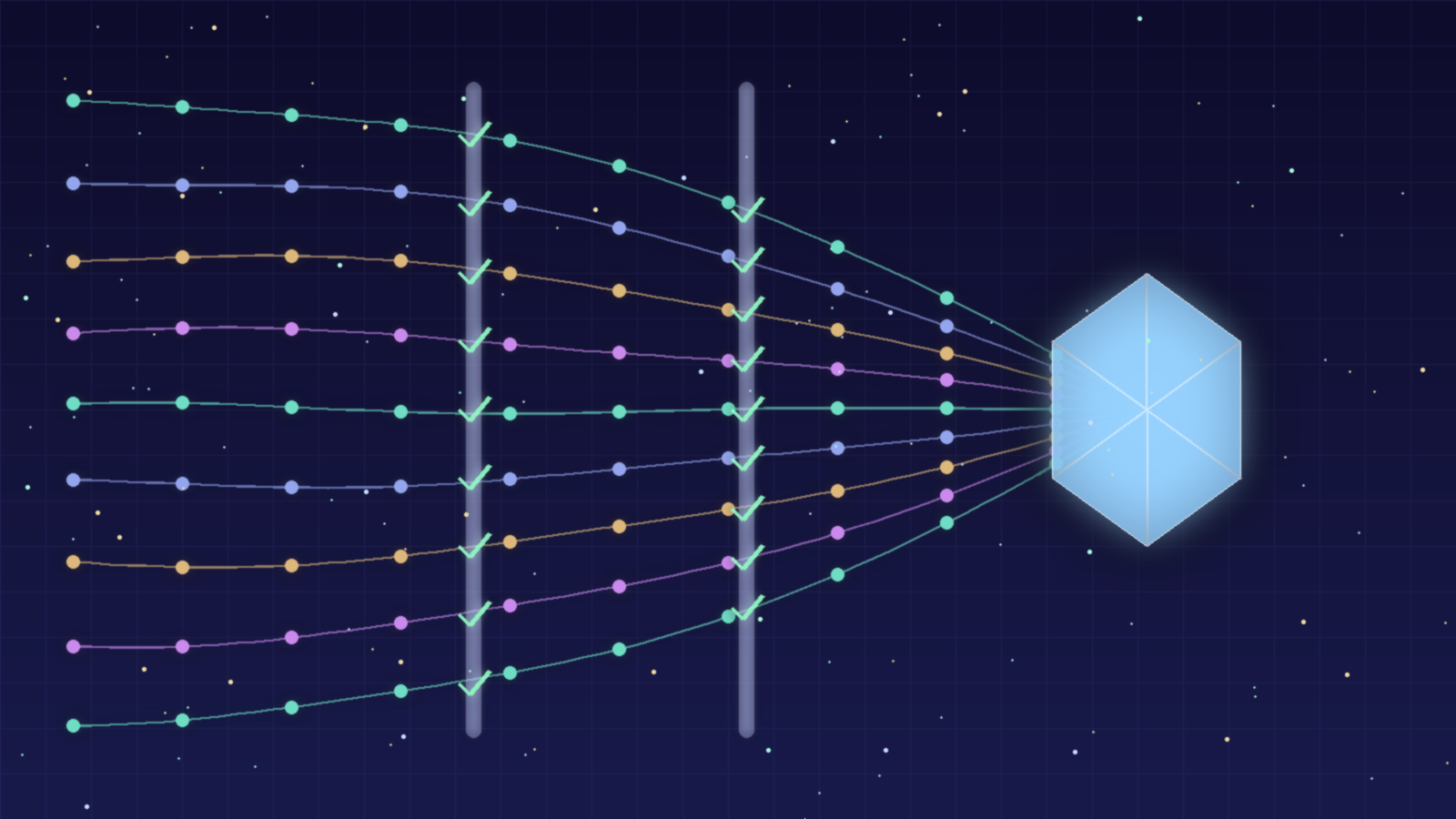
Google says the design targets two weaknesses of current language models. To close the gap between a single attempt and a correct answer, /teamwork pairs parallel exploration with dedicated falsifiers, such as the Lean 4 proof checker, unmodified software test suites, execution simulators and hardware counters, that automatically check which candidate solutions actually work. To keep agents from losing track of details over multi-day tasks, it partitions context so each specialized agent sees only the files and tools it needs, while critics and auditors re-check results from clean contexts.
The headline mathematics result is a proof of the 2013 Courtade-Kumar conjecture in information theory, in full generality. The conjecture says that when a random bit string passes through a noisy channel, no one-bit compression of the input preserves more information than a dictator function that simply copies one input bit. Google credits a division of labor: Gemini found counterexamples to a broader conjecture from an earlier CUHK paper, the CUHK team proposed a candidate function that reduced the problem to a 14-variable optimization along with a key analytical lower bound, and Gemini models produced most of the remaining bounds and interval-arithmetic certificates and extended the proof from balanced to unbalanced functions. The team formalized the proof in Lean 4.
Google describes that formalization as 50 million lines of code. The public repository's own documentation says most of its roughly 45,500 modules are generated numerical certificates checked by Lean's kernel, records zero unfinished-proof placeholders and dependence only on Lean's three standard axioms, and notes acceptance by Lean's comparator tool against a statement in Google DeepMind's Formal Conjectures project. An independent count by the outlet sysnote found that only about 239,000 of the 50.4 million lines are readable proof code; the rest is certificate data.
Google also says its LEAP framework, paired with Argon, fully autonomously produced an end-to-end, machine-checked Lean formalization of the Weil conjectures, the results on counting solutions of polynomial equations over finite fields completed by Pierre Deligne in 1974, spanning about 1.8 million lines across 28,800 subagent invocations. The post lists further formalizations, including more than 919,000 lines for a recent proof of Hilbert's tenth problem over general rings of integers, and says that while formalizing a recent proof of the 3D Bochner-Riesz conjecture the system found and fixed a gap in the informal argument.
On the engineering side, Google says a two-week Argon campaign built on an earlier 25% port of the Zircon microkernel and rewrote the remaining C++ code, adding about 800,000 lines of safe Rust that pass all kernel unit tests and boot on arm64 hardware. A separate port of libgav1, Google's AV1 video decoder, produced around 170,000 lines of Rust with bit-exact parity on a conformance suite; Google says it started about 4x slower than the C++ original and ended 20 to 30% faster after the agents were given profiling tools. Inside Google, the company reports two shipped Borg scheduling changes that cut TPU workload preemption by 24% on some hardware types, and a 30-agent chemistry workflow that reached 95% top-1 exact match on benchmark molecules from NMR data.
Google says external scientists and developers can use Gemini 4 models with /teamwork and /boost in Antigravity today, and that it has opened applications offering 10,000 academic researchers six months of free access to its highest usage tier. The formal-proof pattern and additional workflows are slated for upcoming Antigravity updates.
Readers should weigh the caveats. Times of AI and GetAIBook both note that the results are Google's own descriptions, that the post gives no cost, compute or failure-rate figures, and that a Lean check confirms a proof of the statement as written, not that the formal statement matches the intended theorem, which still requires human mathematicians. AI Aulis reports that Google's post does not provide a complete public environment for reproducing every case. DigiEditorial's account is based on Google Research's post and the public Courtade-Kumar Lean repository, corroborated by Interesting Engineering, Times of AI, GetAIBook and sysnote.