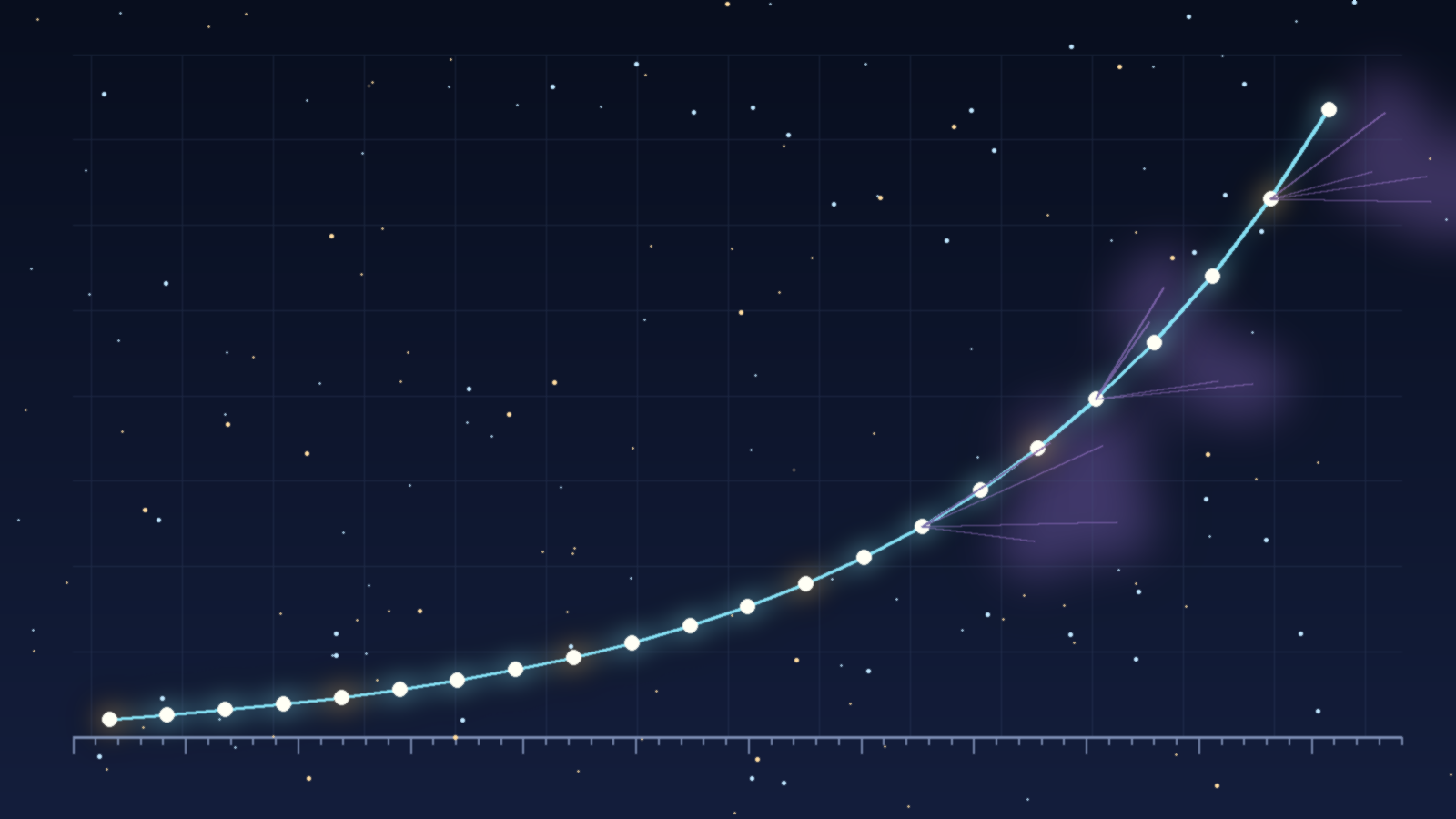
METR, the nonprofit that evaluates frontier AI systems for dangerous capabilities, on November 20, 2026 published its latest update on model capabilities relevant to automating AI research and development. The report covers public models up to Anthropic's Opus 5.5 and OpenAI's GPT-6 Astra, and it updates the group's widely shared 'time horizon' chart, which MIT Technology Review called the most misunderstood graph in AI.
A model's time horizon is the length of task, measured by how long it would take a skilled human, that the model can complete with 50% reliability. Across METR's older Time Horizon 1.1 suite and a new, harder suite called TH2, the group finds horizons doubling roughly every 3.61 months, or about 110 days, with a 95% confidence interval of 2.08 to 4.94 months. That is close to the 105-day trend METR previously reported on Time Horizon 1.1 alone. METR notes that naive extrapolation would put models at its suite's longest 200-hour threshold in July 2027.
The new tasks were needed because the old ones ran out of headroom. METR says that when the time-horizon metric launched in March 2025, the best model managed about one hour; within a year, models had saturated the TH1.1 suite, which includes tasks up to 30 hours. TH2 adds 36 tasks in 12 families, split between verifiable work such as optimization contests, language-model training speedruns and game-playing bots, and harder-to-verify research and judgment tasks scored by people or by models using human-written rubrics.
On verifiable work, the results are striking. METR reports that models usually match or outperform skilled humans on its coding and optimization tasks, and that when it recruited its own baseliners it typically could not find people who beat the current frontier. On 15 of Al Zimmermann's months-long programming contests, the strongest models it tested placed at a median of the 96th to 98th percentile of human entrants, though not at the very top. On the TH2 verifiable subset alone, METR measured a much shorter doubling time of 1.65 months, while cautioning that the data are noisy and that faster trends may simply reflect a narrower set of similar tasks.
Judgment is where the agents fall short. METR asked agents to design a new evaluation task useful for its own research, and says none of the tasks they produced were useful enough to include in the report. On LMCA, a benchmark for rating critiques of philosophical arguments, many models beat expert humans given five minutes, but every public model remained below experts given fifteen. METR also found that model judges inflate scores for work produced by a similarly strong or stronger model; its best-agreeing judge, Opus 5.5, rated Astra's tasks about 0.2 points higher on a 0-to-1 scale than METR's human scorer did.
The report is candid about its limits. Because the new tasks can take humans hundreds of hours, METR says only 9% of its human-time estimates come directly from human baselines, with the rest estimated from public records, experts and extrapolation. It also warns that containerized evaluations increasingly resemble the reinforcement-learning environments used to train models, which could cause them to overstate real-world capability. Experts quoted by MIT Technology Review welcomed the move toward open-ended tasks while cautioning that it is too early to know how progress on them will extrapolate.
METR's overall conclusion is measured but pointed: current public evidence is not sufficient to rule out drastic acceleration of AI research and development in the next couple of years, which it defines as capabilities improving so fast that humans can no longer meaningfully assess and respond to catastrophic risks. It adds that the 3.6-month doubling time is similar to a trend OpenAI recently reported on its own internal research tasks.