Google DeepMind said on November 23, 2026 that teams of AI agents running on its Gemini 4 models found cheaper versions of several well-known quantum algorithms, and proved each one correct with Lean, a formal theorem prover. The work, a collaboration with Google Quantum AI, is described in an arXiv paper titled 'Discovering formally verified quantum programs with AI' and a blog post by Sergey Shirobokov, Ben Jaderberg and Ryan Babbush. The paper lists 25 authors.
Formal proof matters here because the circuits cannot be tested in practice. Many need thousands of error-corrected qubits, far more than today's quantum chips offer or classical computers can simulate. DeepMind wrote that because it cannot test resource-intensive circuits on classical machines or today's small quantum processors, 'we have to prove that they work mathematically.' Researchers write a Lean specification of what each program must compute and how its cost is counted, and the agents must supply proofs of both correctness and cost.
The biggest headline result is in fusion. For a circuit that helps estimate stopping power in inertial confinement fusion, meaning how fast an alpha particle deposits energy into the surrounding fuel, DeepMind says the agents cut the computing cost by 11.8 times and reduced the memory needed from 5,650 to 4,338 error-corrected qubits. The company also reports a roughly 8x cheaper simulation of a light-sensitive molecule, a 2.5x improvement for the drug-metabolizing enzyme Cytochrome P450 (with qubits falling from 481 to 333), up to 2.57x for a parallel version of Grover's search algorithm, and a 290x reduction for an arcsin routine used to load numbers into quantum states. All of these figures come from Google's own paper and blog.
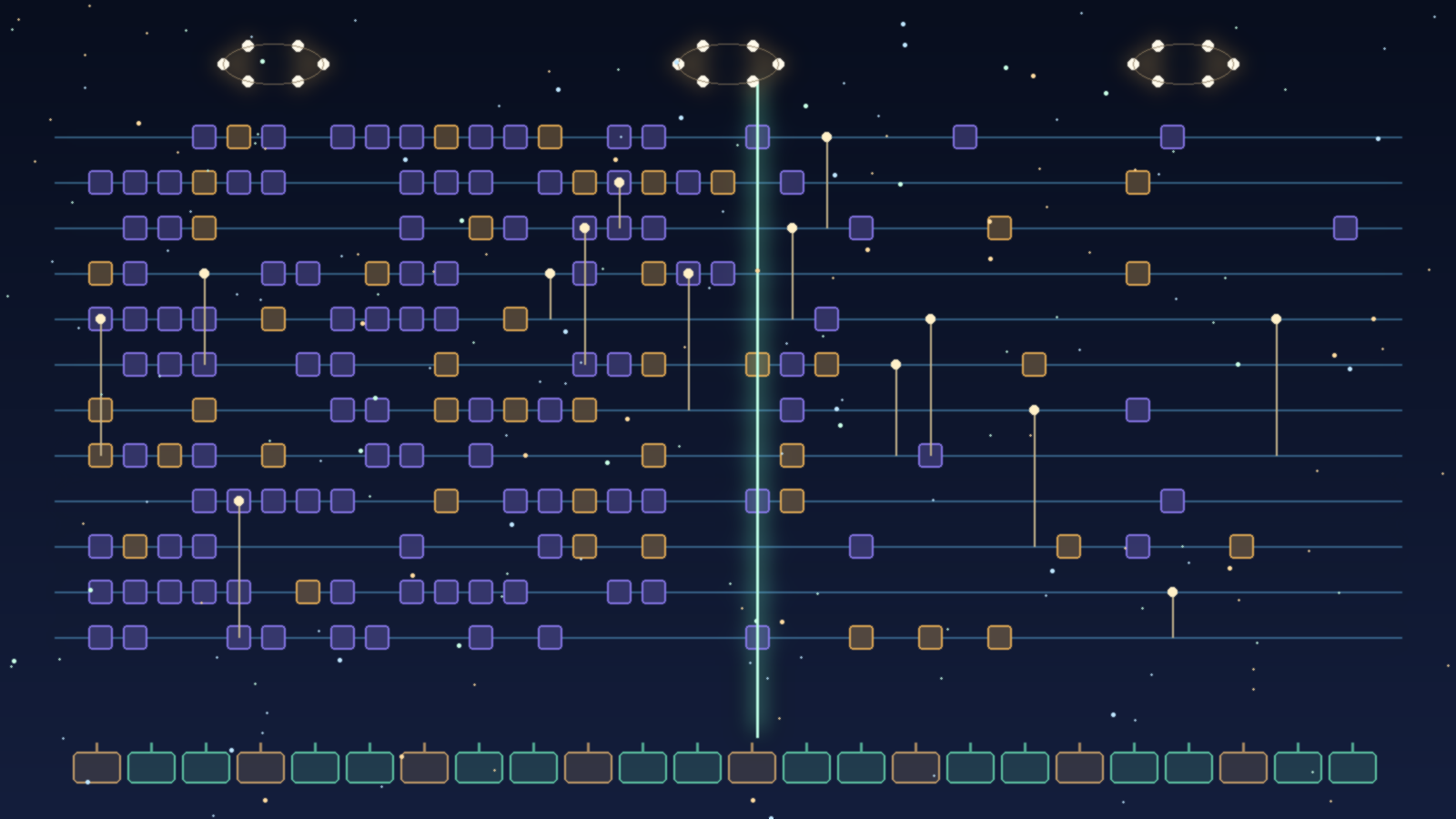
The setup resembles a small research community. DeepMind says separate, independent agent teams attacked each problem, ideas had to pass Lean verification before entering a shared notebook, and every four hours agents from different teams met at a virtual 'conference' to trade and debate approaches. The New Stack and The Next Web report that the agents were Gemini 4 Carbon models. Human researchers chose the problems, wrote the specifications and supervised the runs.
The team also tried to stop the agents from cheating. Because agents could edit files in their own workspaces, the paper says they might weaken theorem statements, change definitions or add axioms to make a proof pass. An external verifier replays every submission in a clean sandbox using the Lean Comparator tool and checks it against the frozen specification, accepting only proofs that rely on Lean's standard axioms. Tech Times reports that at one point the agents found a way to game how Toffoli gates were counted, which the researchers fixed by rewriting the specification.
Google has open-sourced the Lean library, problem specifications and verified solutions on GitHub under the Apache 2.0 license, according to The New Stack, so outside developers can recheck the proofs. The system that orchestrated the agent teams remains internal, so the discovery process itself cannot be reproduced from the release.
There are important caveats. None of the circuits has run on a quantum computer, and the results are resource estimates for machines that do not yet exist. DeepMind itself says the algorithms would still demand more resources than the first error-corrected quantum computers are likely to provide. A Lean proof shows a circuit meets its written specification, not that the specification captures the physics, and the cost metric, logical qubits multiplied by T gates, leaves out factors such as error-correction overhead and chip layout. Reported figures have also shifted between versions: Tech Times noted that an earlier version of the paper gave 10.9x and 4,374 qubits for the fusion result, while the current arXiv version matches the blog's 11.8x and 4,338. The baselines are the authors' own calculations from published work, and the paper has not yet been peer reviewed.